|
...1970's & 1870's
plus in between times
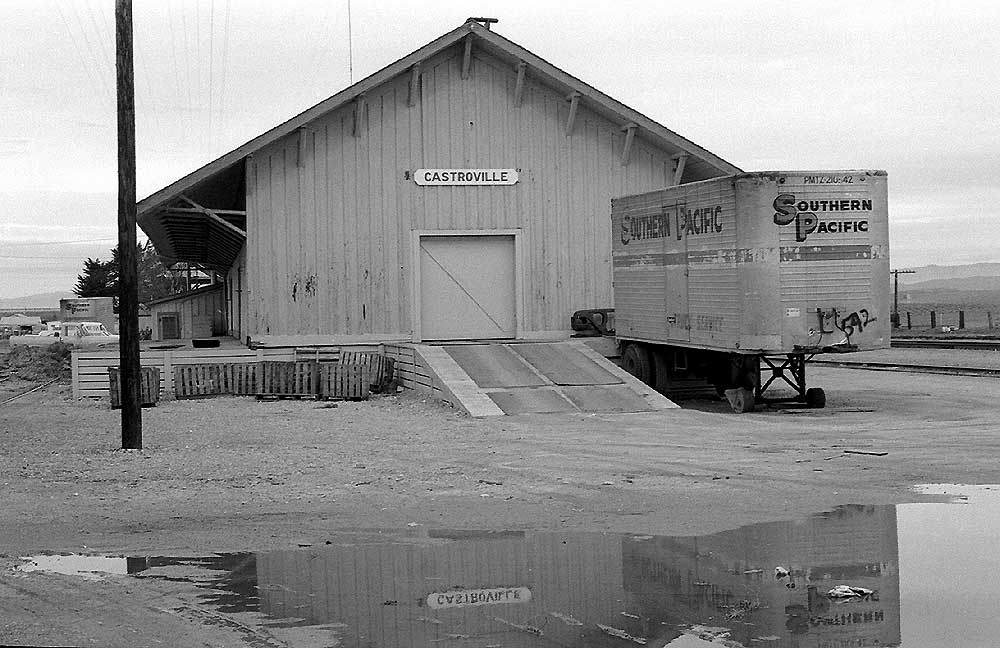
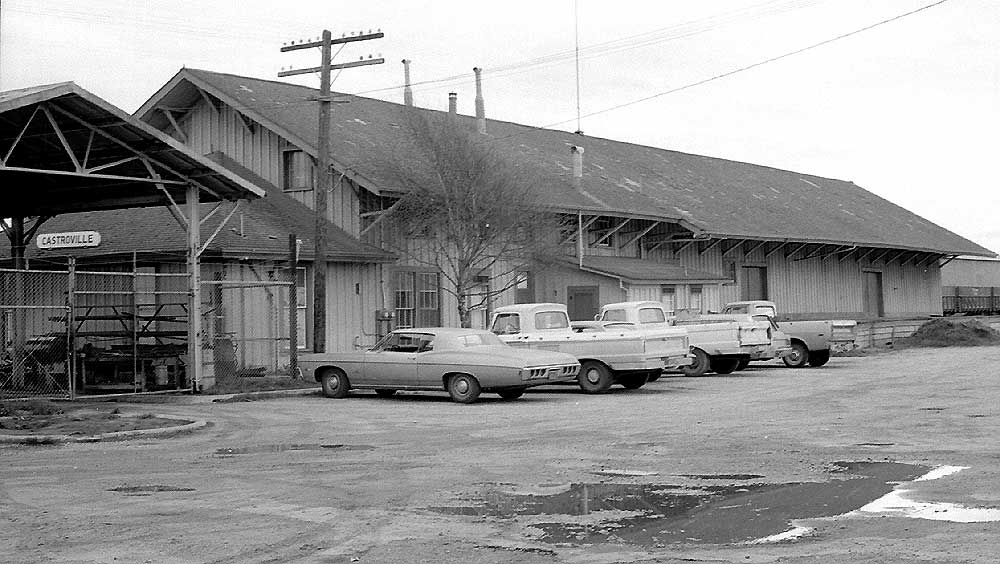
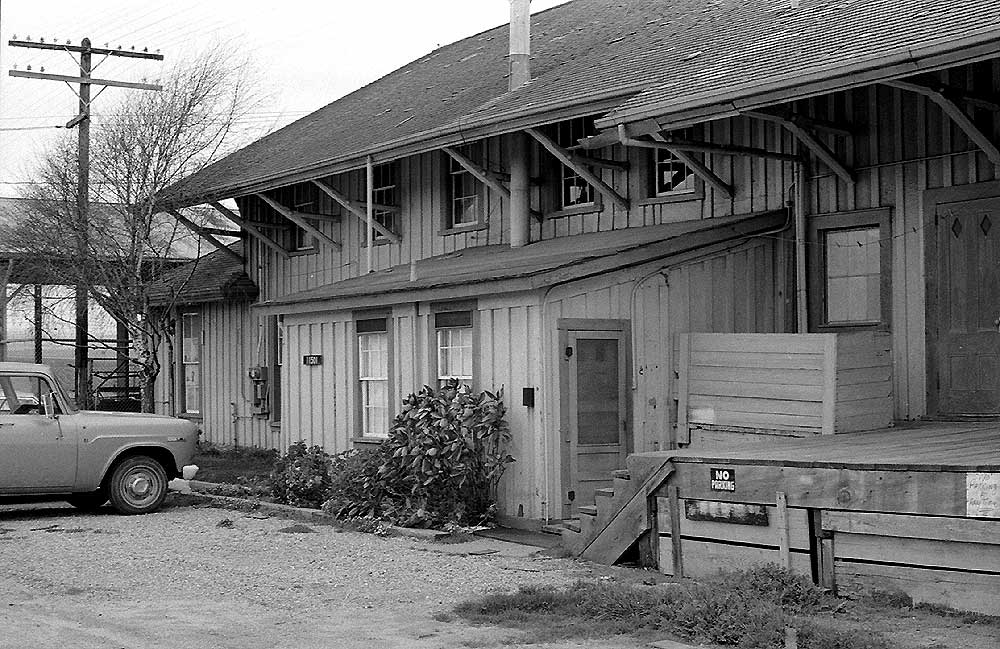
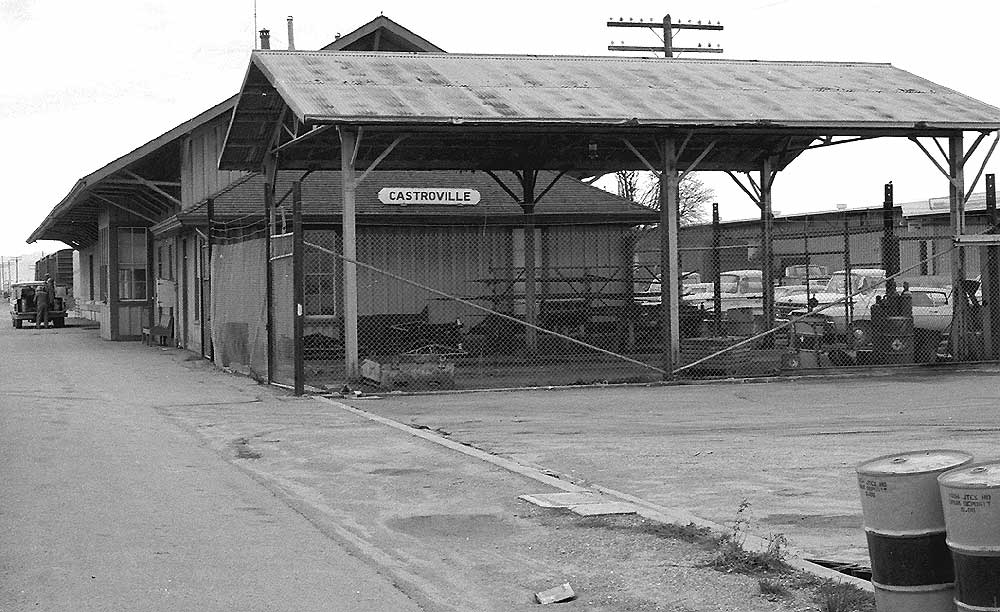
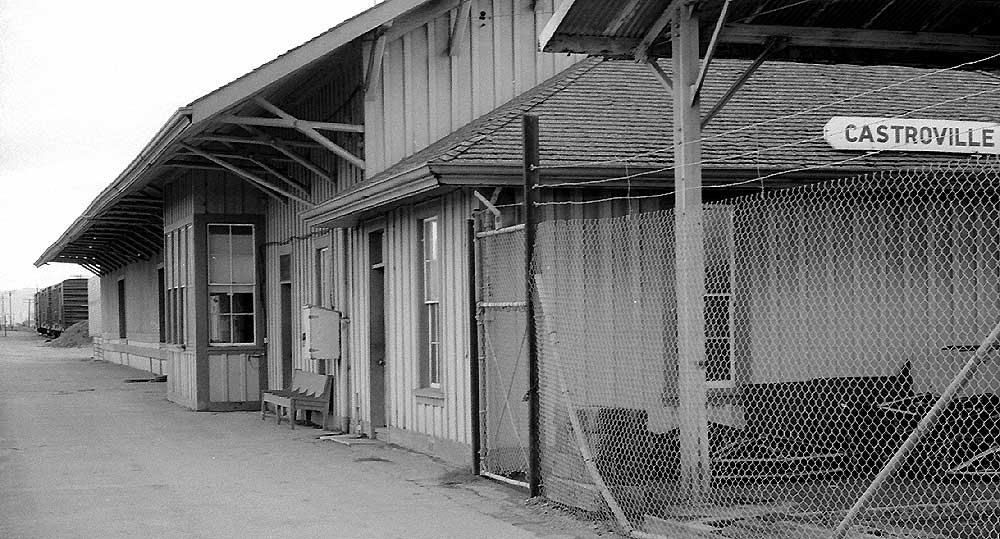
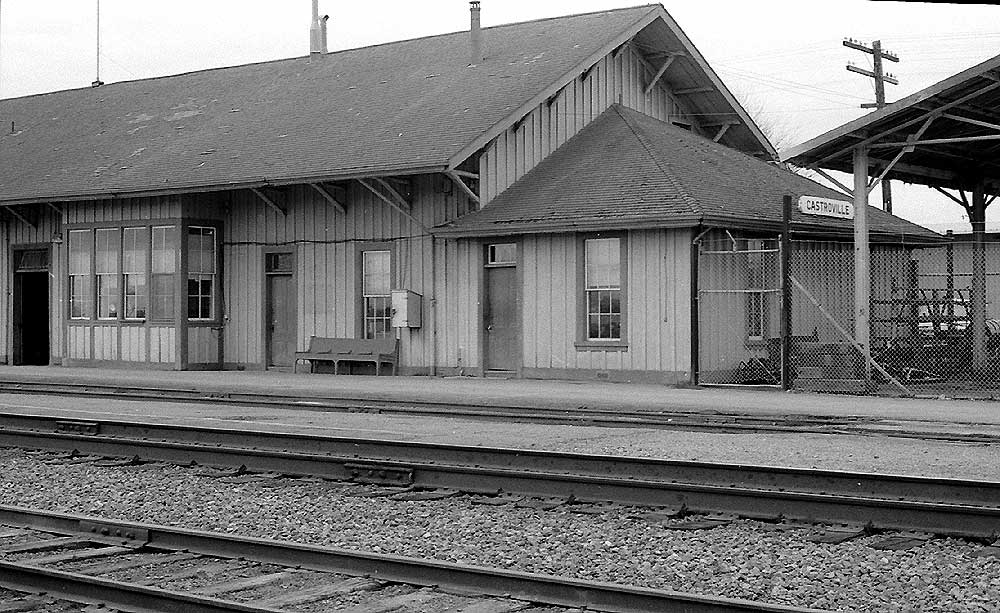
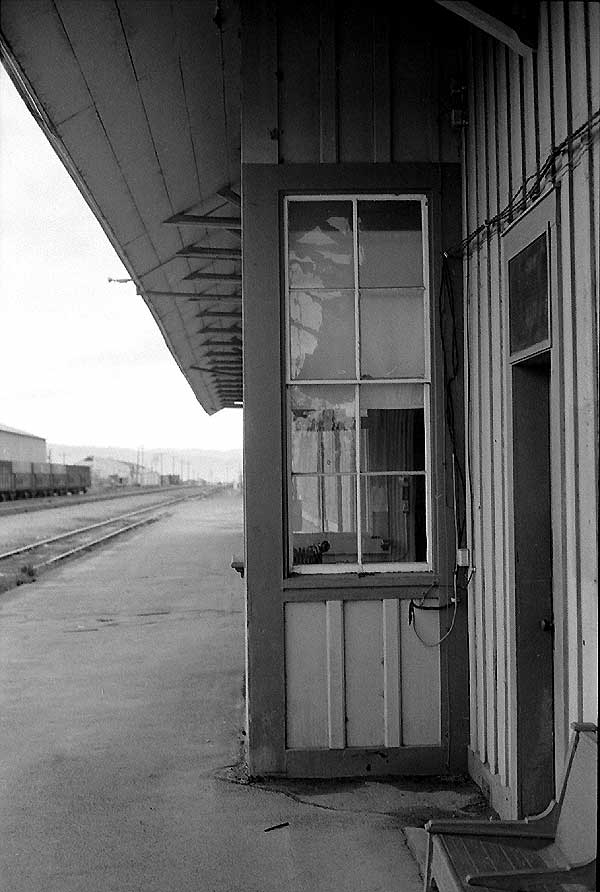
If ever there was a a depot building that perfectly reflected a farming community, the SP station at Castroville surely was it. Over the many years since it was built in 1869 (+ or -), it evolved in much the way that a farmer's barn evolved - with cost-effective, good-enough additions constructed out of practical need, rather than stylistic consideration - the railroad equivalent of "farm construction".
Located at the head of the Salinas Valley, Castroville was the junction point for the now-abandoned Monterey Branch, and indeed was listed as Del Monte Junction in early Twentieth Century timetables. The town is famed for its artichoke production, although brussel sprouts and other crops that favor its cool oft-overcast coastal climate also grow in abundance nearby. Given that the area produces three-quarters of the world's 'chokes (and all of the Globe variety: the best), it's self-proclaimed status as the "Artichoke Capital of the World" is on the mark. Every May, Castroville hosts an Artichoke Festival that features a car show, foot race and all of the other fare that is expected of such events.
The first photos here date to early 1974, after its last two passenger trains that called there, the Coast Mail and the Del Monte, were dropped. The last photo records a short SP passenger train sitting across the tracks from the depot about a century earlier.
|
 |
|
|
|
In the meantime, in between times...
Norma Jean, Artichoke Queen - and other tales of Del Monte Junction
(with thanks to Monterey Branch historian Dave Hambleton for vital data)
Southern Pacific has rarely been accused of sensitivity towards the communities it served, unless there was some money to be made, or a public relations point to be scored. Such were the circumstances on July 22. 1913, when Southern Pacific screwed Castroville. On that date, in order to (somehow) promote travel to subsidiary Pacific Improvement Company's Hotel Del Monte, SP erased Castroville as a station name in favor of Del Monte Junction. The revisionist title did not sing to locals.
In assessing the new arrangement, the Monterey American led off its report with, "Castroville, like Pajaro, has been obliterated by the action of the railroad company." Quixotically, SP explained that the change came because Easterners could not pronounce its Spanish name. By implication this meant that, as the American cynically put it, "The Easterners will probably not strangle on Del Monte Junction, which is really quite a good name and easy to pronounce."
|
Of course, such a negative review could not be countenanced by rival newspaper Monterey Daily Cypress, which summarily pronounced it an "Excellent idea," adding that "It would benefit Monterey", since "passengers would know that when Del Monte Junction was called out on the train that it was the changing place for the whole Monterey Peninsula," on account that "Monterey and Del Monte are always associated together." Apparently, one might conclude from this that calling out, "CASTROVILLE, Castroville next! Change here for Hotel del Monte and the Monterey Peninsula," had had already proved to be an ineffective solution because of the language barrier.
Faithful and loyal Castrovillians were forced to live with this indignity until SP finally relented and reverted back to calling the place Castroville on August 15, 1933. We do not know whether the main impetus for the change was Castroville Chamber of Commerce efforts to reclaim the depot, or reports that passengers had frequently disembarked the trains at the Junction thinking that it was the Hotel Del Monte stop (presumably beginning with the first train to call at the Junction back in 1913).
The grand restoration of sorts was unfortunately and unceremoniously treated as column inch filler by local newspapers, with one reporting the Junction" name as being a quarter century old, and two others dating it to 1908. But by then the fair folks of Castroville by then were too busy growing a novelty - artichokes - to worry much about these transgressions.
|
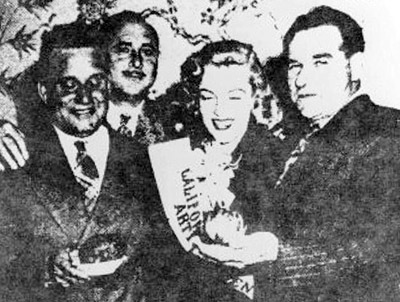 Artichoke Queen Norma Jean looking very uneasy in the presence of Castroville's Jewelry King
|
Castroville's ultimate revenge came from prospering while Hotel Del Monte's business withered. A couple years before the depot sign reverted back to "Castroville", the town had begun hyping itself as "The Artichoke Center of the World" and had erected a massive sign arching over its main street to emphasize this to lost, wandering tourists looking for the Hotel Del Monte. The artichoke boom never went bust during the Depression, and in 1959 the town began hosting an annual Artichoke Festival that survives to this day. Of course, any festival worth its salt needed a queen, but the first semi-official Artichoke Queen actually appeared much earlier. Back in 1948 the owner of a local jewelry store had bestowed the honorific upon a young starlet named Norma Jean Baker whom he had hired to hawk his merchandise. Yep, that Norma Jean, aka Marilyn Monroe, and she wowed 'em (see photo).
|
|
The thing is, being somewhat of a specialty crop, artichokes rarely traveled to market in freight car size lots, so SP was not able to cash in much on the culinary phenomenon. Besides that, Hotel Del Monte ultimately had not been quite the traffic draw that SP had hoped. The hotel burned down in 1924, five years after the Charles Crocker interests sold out. The rebuilding took two years, but by that time, the automobile was making serious inroads (this is a pun) into to SP's passenger business. Then came the Great Depression, when 'luxury' hotels became 'unaffordable luxury' hotels to the former members of the monied class. Hotel Del Monte closed its doors to the public (speculatively to the relief of its owners) in 1942 to support the war effort as a Naval pre-flight school. In 1951 it officially became the Naval Postgraduate School, as it so is today.
Meanwhile, Del Monte ceased entirely as a passenger stop with the coming of Amtrak, while Castroville's artichoke business continued to climb. One hopes that the solace derived of watching from above as an even larger Octopus gobbled up Southern Pacific in 1996 provided a yet even more serene afterlife for those dearly departed souls of Castroville who endured the mighty indignity of Del Monte Junction.
|
|
|
|
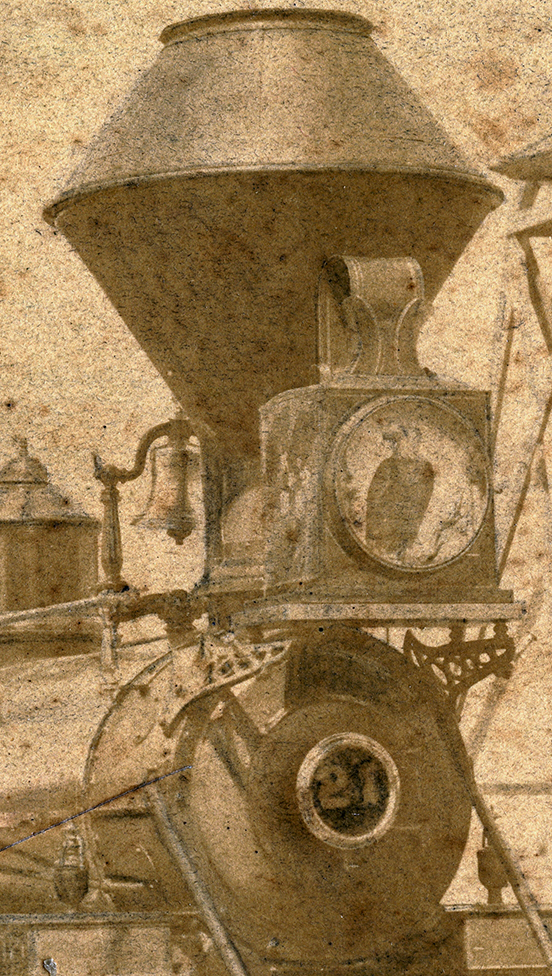
circa 1874
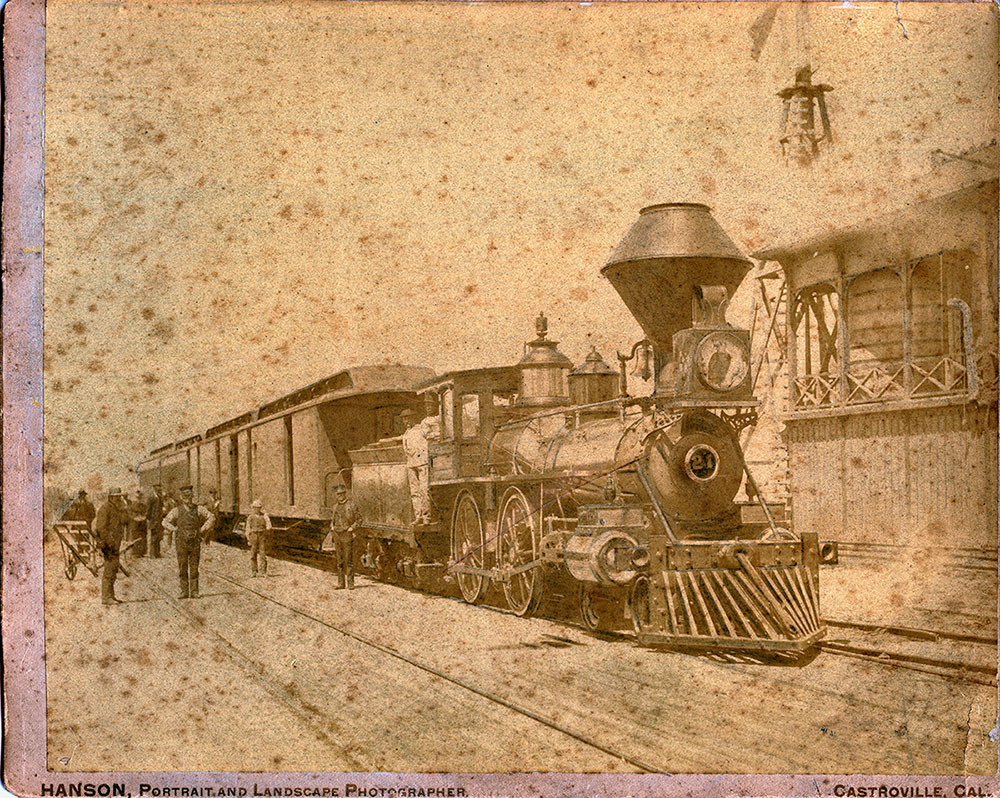
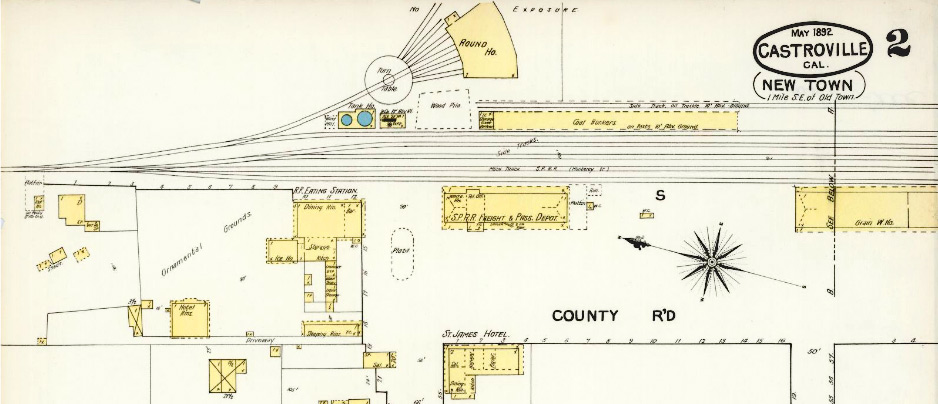
Wx4 recently acquired this chickenpox-plagued parlor photo of what we assumed to be SP 4-4-0 # 21 at Castroville. We checked with Dave Hambleton, the reigning authority on SP in the area. He confirmed that this indeed Castroville, and that this is the earliest SP photo that he has seen of same. Better yet, he supplied us with an 1892 Sanborn Fire Insurance Map that shows the precise location of the train: timetable eastbound in front of the tank house depicted by the two blue circles on the map.
What remains to be nailed down is the approximate date. The fancy decor (note the bald eagle painted on the headlight glass) of #21 suggests that this scene might have been recorded shortly after the locomotive went into service (according to Diebert and Strapac) on March 15, 1875. We have so far found no record of photographer Hanson, although there was a commercial photographer of that name located in Santa Cruz in the early 1890's. Perhaps one of you viewers can identify the cars and their date of manufacture? wx4org@yahoo.com
|
|
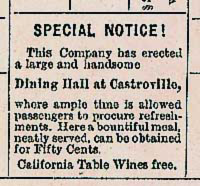
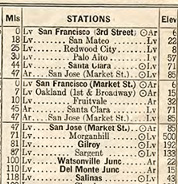
A notice (above left) for a new dining hall at Castroville appeared in an 1891 SP public timetable. On the Sanborn map above, it is the "RR Eating Station" just north of the depot.
Where's Castroville? (above right) Between approximately 1913 and 1933, SP renamed its Castroville station to Del Monte Jct., surely to the embarrassment of the good town's fathers. Likewise, this must have nonplussed a passenger wanting to get off in Castroville to visit grandma. Know the exact dates? wx4org@yahoo.com
|
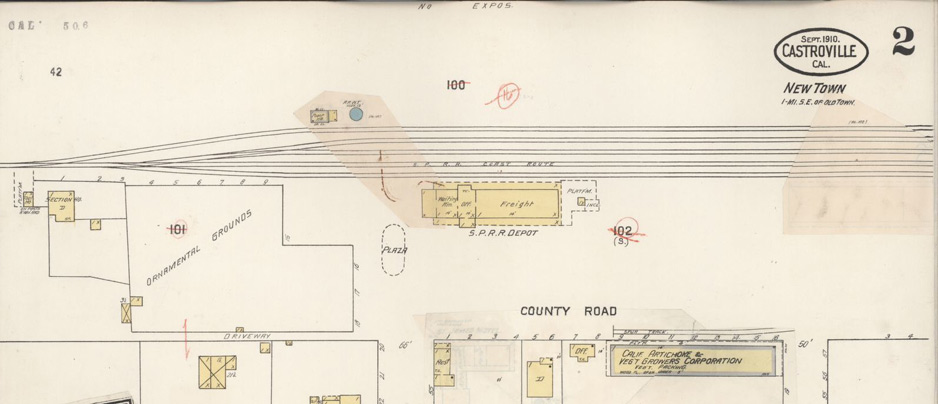
The above Sanborn map show how diminished the layout was in 1910. (Click on the map for an enlarged version) Sometime between 1895 and 1907 Castroville lost its status as a subdivision point (in favor of Salinas) where main line crews and locomotives changed, along with its meal stop.
|